
6 min read
Pull Force: Why Magnets Hold Less Than Promised
Datasheet pull force only applies under ideal conditions. Find out what shrinks it in real life and how to plan realistically.

The package says "pull force 44 lb," yet on your fridge door the hook slides down under a single dish towel. Sound familiar? You are not alone. The number on the datasheet is not a lie, it simply describes an ideal case that almost never happens in everyday life.
In this guide you will learn how pull force is measured, which factors shrink it in the real world, and which rules of thumb help you size up a magnet realistically. That way you pick the right one the first time.
01
What does pull force actually mean?
Pull force, also called holding force, is the force needed to pull a magnet straight off a steel surface. Manufacturers usually state it in pounds, kilograms or newtons. It is measured with a force gauge: the magnet sits on a steel plate and is pulled straight up until it lets go. The peak value just before release is the rated pull force.
The test conditions are what matter. The German retailer supermagnete.de, for example, measures on a steel plate 2 cm (about 0.8 in) thick. The US company K&J Magnetics describes similar ideal conditions: a thick, uncoated steel plate much wider than the magnet, a clean surface and no gap at all. That is exactly the combination you rarely find at home or in the shop.

02
The air gap: the biggest force killer
Nothing weakens a magnet as much as distance. Attraction falls off very quickly as the gap grows. According to supermagnete.de, a gap of just 0.5 millimeters (about 0.02 in) can roughly cut the holding force in half. That sounds tiny, but you create gaps like that all the time without noticing.
- Paint and powder coating: the finish on a fridge, whiteboard or radiator acts like a small spacer.
- Paper, film, fabric: anything you hold with the magnet sits between it and the steel.
- Rubber or plastic covers: they protect the surface but add distance.
- Dirt and rust: crumbs, shavings or rust layers lift the magnet.
That is why a magnet holding ten sheets of paper holds far less than the same magnet on bare steel.
03
Steel type and thickness
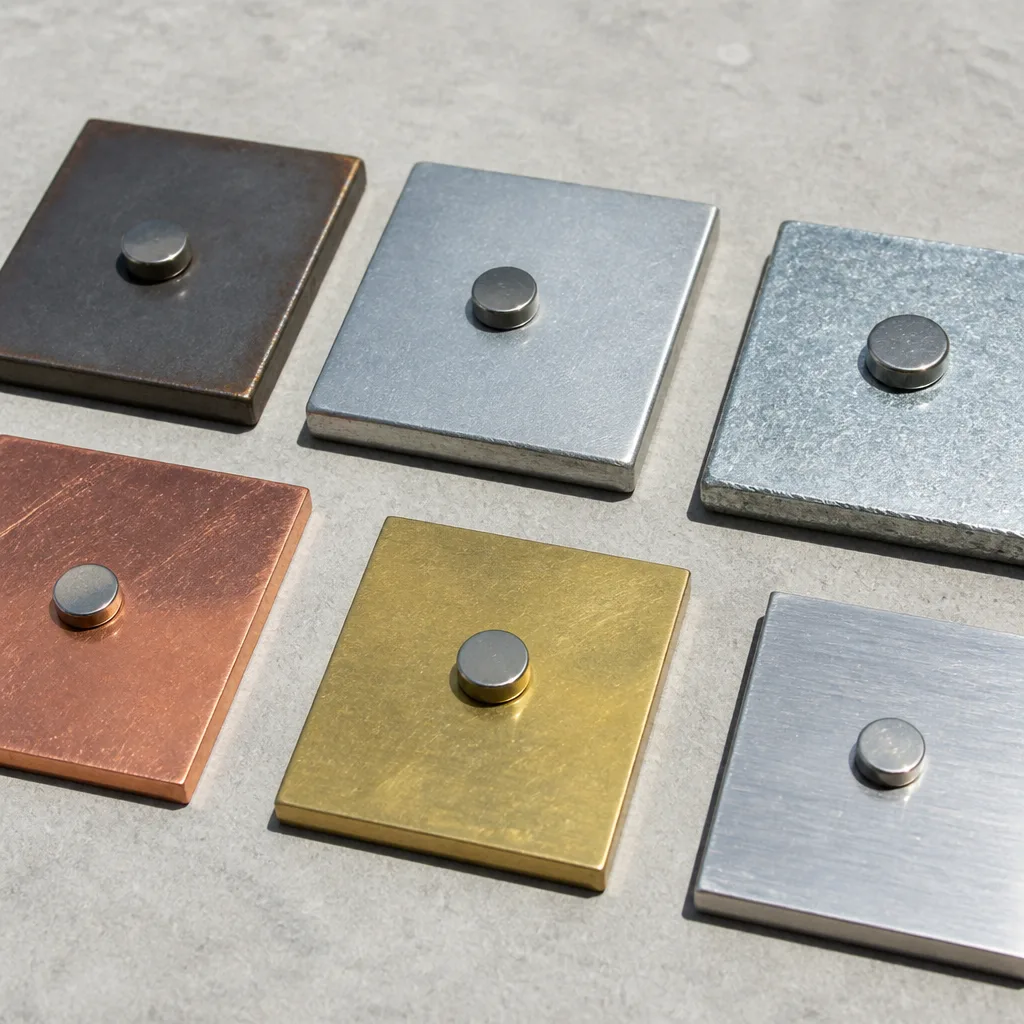
Not every metal is equally magnetic. Pure soft iron is the ideal. On ordinary structural steel such as S235, supermagnete.de says holding force drops by only about 5 percent, while on some harder steels it drops by around 30 percent. Aluminum, copper and brass barely attract magnets at all, and many stainless steels are only weakly magnetic or not magnetic.
Thickness matters just as much. A thin sheet can only carry a limited amount of magnetic flux before it saturates. The rest of the field passes through and does not help the magnet hold. K&J Magnetics gives a clear example: a disc magnet 1/2 inch across and 1/4 inch thick reaches only about 45 percent of its rated pull force on the thin steel of a typical refrigerator door. To get full force it would need steel about 0.073 inch (under 2 mm) thick.
Area counts too. If the steel piece is smaller than the magnet's contact face, you also lose force.
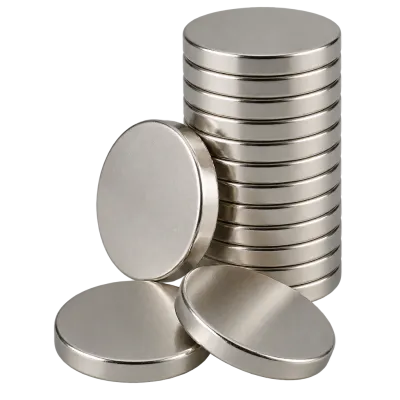 Matching productNeodymium disc magnets setAmazon →
04
Pull versus slide: holding force and shear force
The datasheet value only applies when the load pulls perpendicular to the surface. If you hang something from a magnet on a wall, the load acts parallel to the surface. Then only friction keeps the magnet in place, and friction is much weaker.
supermagnete.de puts this shear or sliding force at roughly 15 to 25 percent of the holding force, and closer to 15 percent for neodymium and ferrite magnets on iron. So a hook magnet rated at 50 kg (about 110 lb) will carry roughly 7.5 kg (about 16 lb) on a vertical wall. A rubber coating, a silicone pad or a rougher surface improves friction, and the manufacturer says up to about 50 percent is then possible.
| Situation | Rough share of rated pull force |
|---|---|
| Straight pull, thick bare steel, no gap | up to 100% |
| Structural steel S235 instead of soft iron | about 95% |
| Air gap of 0.5 mm (0.02 in) | about 50% |
| Thin refrigerator door steel (K&J example) | about 45% |
| Load parallel to the wall (shear) | about 15 to 25% |
| Shear with rubber coating | up to about 50% |
These figures come from manufacturer data and depend heavily on magnet shape and size. Treat them as a guide, not a guarantee. When several factors combine, the losses multiply.
 Matching productHook magnetsAmazon →

05
Other influences: temperature, corrosion, shape
Beyond gap, steel and direction, a few more things play a role. Standard neodymium magnets are usually rated up to about 80 °C (176 °F). Above that they lose strength permanently. Moisture can attack the coating, and a rusting magnet gets weaker. The shape and magnetization direction also affect the achievable force, as does a smooth or rough surface.
Pot magnets, also called cup magnets, are a special case. The magnet sits in a steel cup that concentrates the field on the contact face. That gives very high values on thick steel, but it also makes the magnet especially sensitive to gaps and thin sheets. They are still popular for magnet fishing because they are so rugged.
 Matching productMagnet fishing kitAmazon →
06
Rules of thumb for everyday use
A few simple rules lead to better buying decisions:
- Build in a safety margin: buy considerably more pull force than you calculate, especially with paint, paper or thin sheet metal involved.
- Divide by 6 or 7 for wall mounting: under shear load, roughly one sixth to one seventh of the rated force remains.
- Minimize the gap: every fraction of a millimeter counts. Direct contact beats any cover.
- Mind the sheet: on thin steel, larger flat magnets or several small ones often do better than a single thick one.
- Stop the slide: a rubber coating adds friction and therefore load capacity on a wall.
- Do not trust it overhead: if something heavy hangs above people, do not rely on a magnet alone.
The most reliable approach is your own test under real conditions. Place the magnet exactly where it will sit later, with the same paint and the same material in between. Then add weight step by step, for example with a bag and water bottles, and watch when it slides or pops off. Keep the actual load well below that point. Also expect shocks, such as slamming doors or vibration in a vehicle, to knock a magnet loose sooner than a steady load. For moving or safety related uses, a mechanical backup like a stop, a screw or a safety cord is worth adding.
07
Frequently asked questions
Why does my magnet hold much less than the rating?
Because the rating is measured under ideal conditions: thick bare steel, no gap, straight pull. In real life, paint, thin sheet and shear loads often reduce the force a lot.
Does stacking two magnets help?
Often yes, up to a point. Several magnets can raise the force, but each extra magnet adds less, and on thin steel saturation holds you back.
Is it correct to state pull force in pounds or kilograms?
Strictly speaking, force is measured in newtons. Pounds and kilograms are a common shorthand for the weight a magnet can hold in a straight pull. One kilogram corresponds to about 9.81 newtons.
Will a magnet stick to stainless steel?
That depends on the type of steel. Many common stainless steels are barely or not at all magnetic, so test with a small magnet first.
Sources:
Explore
Read next
 Types of MagnetsFrom bar magnets to neodymium super magnets: an overview of the most important types of magnets and their uses.
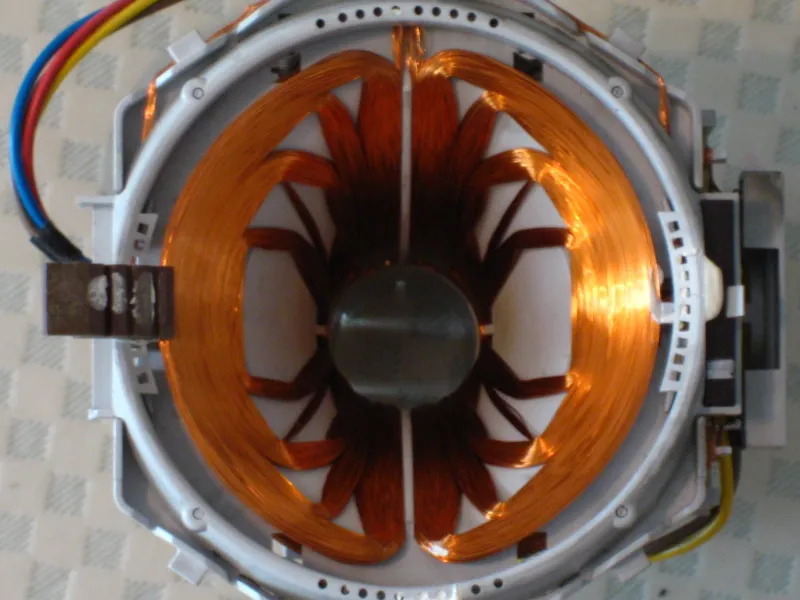 Uses of MagnetsMagnets are used far beyond speakers and fridges: learn about their role in data storage, deflection magnets and relays.
 Magnetism: What Is It?What is magnetism, how does it arise physically and what can you do with it? We take a closer look at this fascinating phenomenon.