
6 min read
Maglev and More: How Magnetic Levitation Works
Why magnets cannot float stably on their own, and how maglev trains, magnetic bearings and floating globes pull it off anyway.
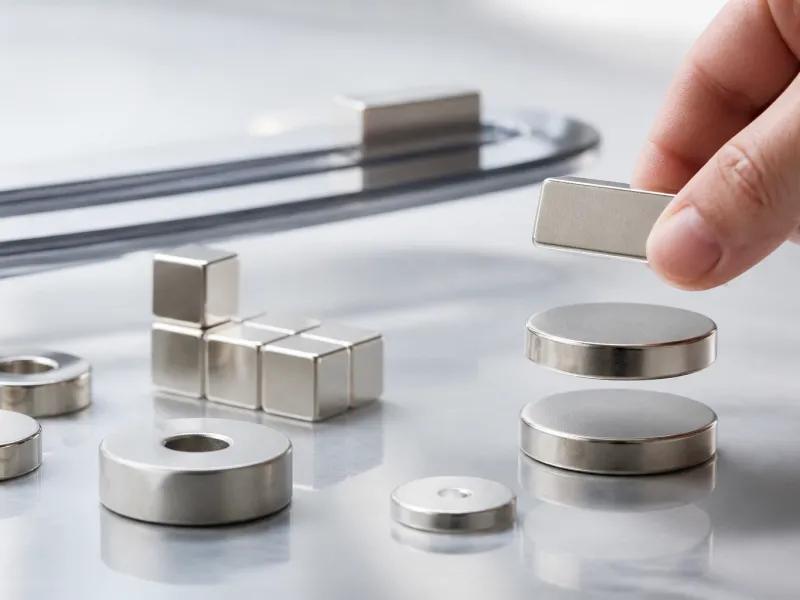
A train that glides along its guideway without wheels. A globe that spins freely in midair. A shaft that turns at tremendous speed without touching anything. Magnetic levitation looks like a magic trick, but it rests on solid physics, and that physics is surprisingly easy to grasp.
In this guide you will learn why magnets cannot actually float stably on their own, which tricks engineers use to make them float anyway, and where you meet levitation technology today: from the Transrapid and the Shanghai airport line to Japan's SCMaglev, from magnetic bearings in industrial pumps to the floating gadget on your desk.
01
Earnshaw's theorem: why magnets don't simply float
Maybe you have tried it yourself: you hold two magnets above each other with like poles facing and hope the top one will just hover. Instead it tips sideways, flips over and snaps onto the lower one. That is not bad luck, it is a law of nature. Back in 1842 the British mathematician Samuel Earnshaw proved that a set of stationary charges cannot be held in stable equilibrium by electric or magnetic forces alone. The same idea applies to stationary permanent magnets.
Here is an intuitive picture: a stable floating point would be like a marble in a bowl that rolls back to the center every time you nudge it. Static magnetic fields never form such bowls. At best they create saddle points, where one direction pulls you back toward the middle while another pushes you straight out. Some direction is always unstable.
The theorem does have loopholes, and every levitation technology exploits one of them:
- Active control: sensors constantly measure the gap, and electromagnets are adjusted in a split second.
- Diamagnetism: materials such as pyrolytic graphite or bismuth are repelled by magnetic fields and can therefore float stably.
- Superconductors: they expel magnetic fields (the Meissner effect), and some types also lock the field in place.
- Motion: a spinning top or a moving train does not meet the theorem's assumptions, because it only covers static arrangements.
- Mechanical guidance: if a wall or a thread blocks the unstable direction, you get what is called pseudo-levitation.
02
Two ways to float a train: EMS and EDS
Maglev trains fall into two broad families. Both run without wheel contact, but they get there in very different ways.
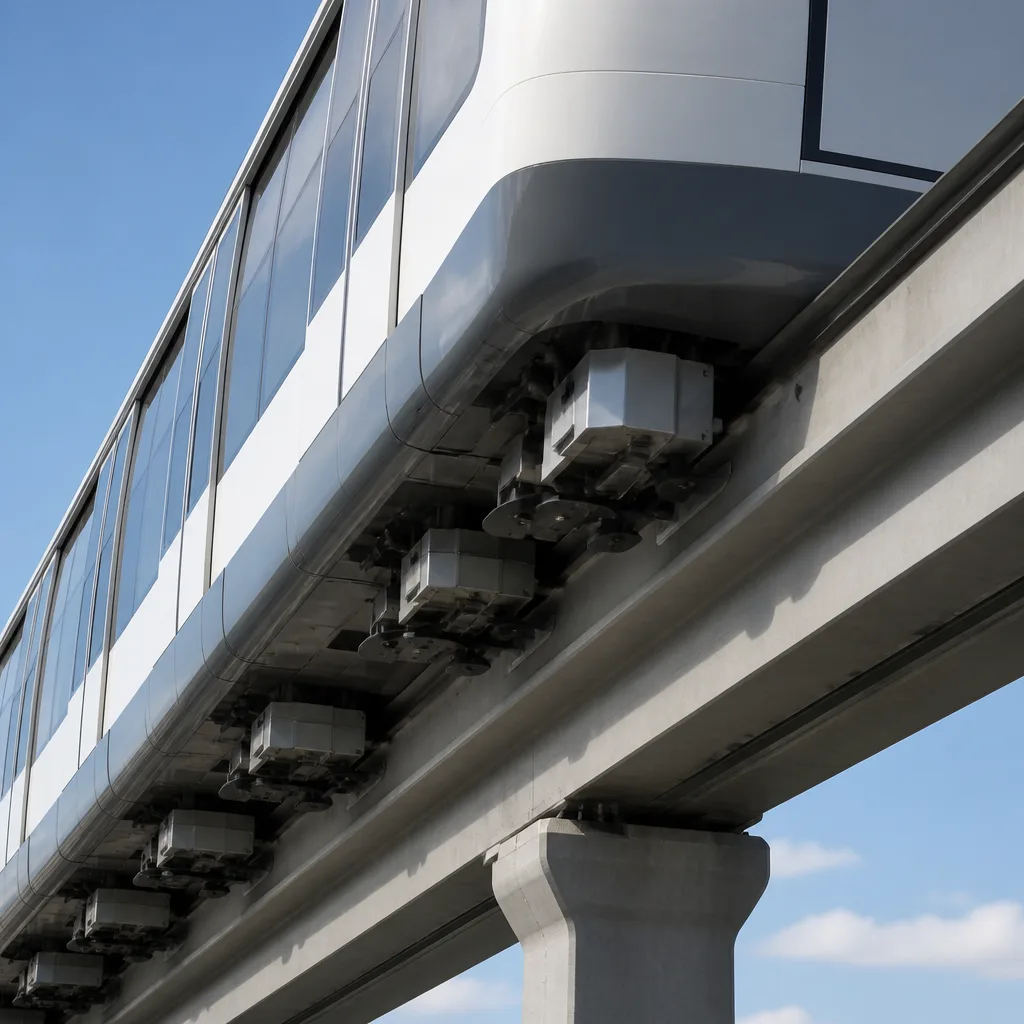
With electromagnetic suspension (EMS) the vehicle wraps around the guideway. Electromagnets on its underside are pulled upward toward a steel rail from below, which lifts the train. Because pure attraction is unstable, sensors monitor the gap continuously and adjust the current. The big advantage: the vehicle hovers even when it is standing still.
With electrodynamic suspension (EDS) the vehicle carries very strong magnets. As it passes coils in the guideway, induction creates currents in them, and their magnetic field pushes the train up and away. This only works above a certain speed. Below that, the vehicle rolls on wheels.
| Feature | EMS (e.g. Transrapid) | EDS (e.g. SCMaglev) |
|---|---|---|
| Principle | attraction, actively controlled | repulsion from induced currents |
| Air gap | about 10 mm | about 100 mm |
| Hovers at standstill | yes | no, uses wheels at low speed |
| Magnets on the vehicle | conventional electromagnets | superconducting magnets |
03
Transrapid and Shanghai: German engineering in China
The Transrapid is the best known EMS system. Planning started in Germany in the late 1960s, and a test facility opened in the Emsland region in 1983. The gap between vehicle and rail is held nearly constant at about 10 millimeters and checked up to 100,000 times per second. A frequently quoted detail: the vehicle needs less power to hover than to run its air conditioning.
The only commercial Transrapid line in the world is in Shanghai. It links Longyang Road station with Pudong International Airport over roughly 30 kilometers. Regular service began at the start of 2004, and the ride takes just over eight minutes. For years the train ran at up to 431 km/h (268 mph) in scheduled service. Since 2021 it has been capped at 300 km/h (186 mph). During a test run in November 2003 it reached 501 km/h (311 mph).
In Germany the Transrapid never entered regular service. In 2006 a train crashed into a maintenance vehicle on the test track near Lathen, and 23 people died. The cause was human error in operating procedures, not the levitation technology itself. In 2008 a planned airport link in Munich was canceled because of rising costs, and the Emsland facility closed in 2011.
04
SCMaglev: Japan's record breaker
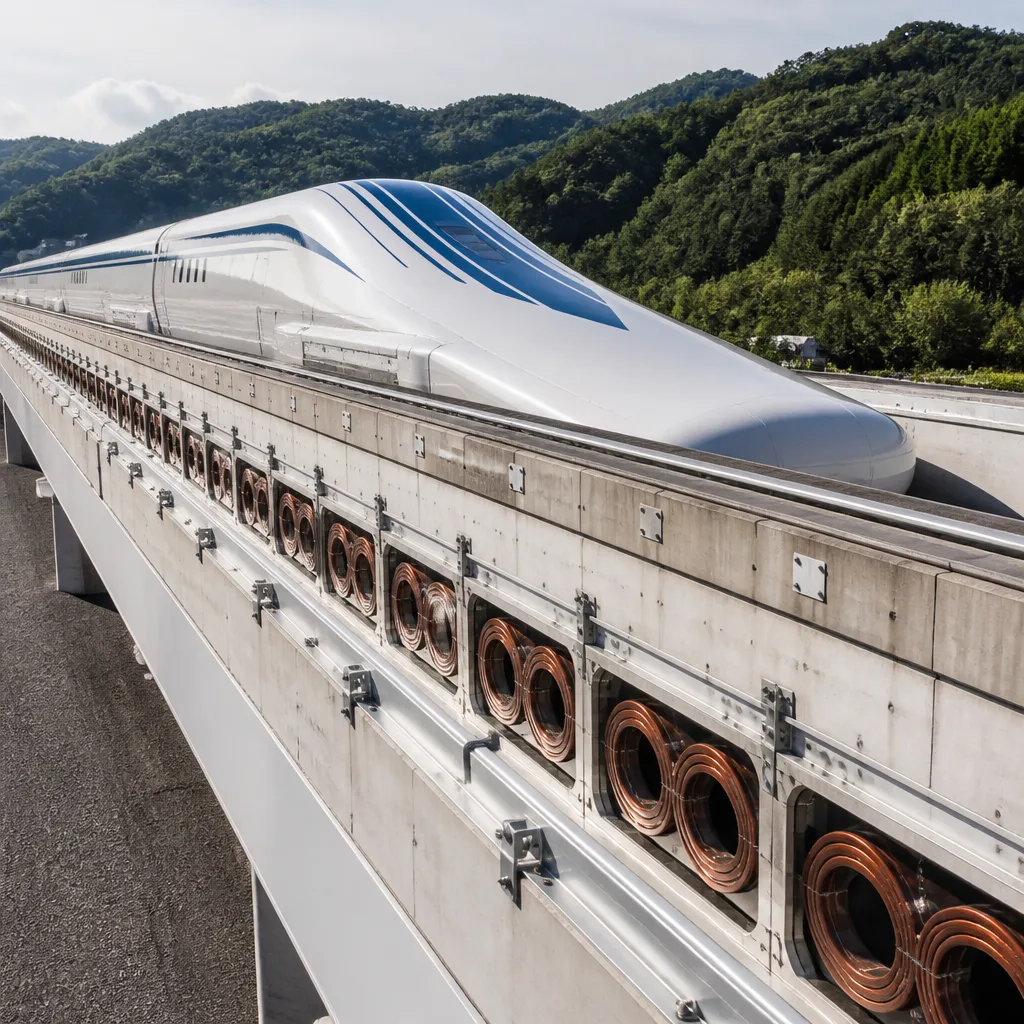
Japan chose the EDS route with its SCMaglev. Development goes back to the 1960s, and a first successful test run took place in 1972. Superconducting magnets sit in the train's bogies, while figure eight coils line the side walls of the guideway. From about 150 km/h (93 mph) enough current flows to lift the train around 10 centimeters (4 inches). At lower speeds it rolls on rubber tires.
On April 21, 2015, an L0 series train hit 603 km/h (375 mph) on the Yamanashi test track. That is still the world record for a crewed rail vehicle. In everyday service the technology is meant to run on the Chuo Shinkansen, which will connect Tokyo with Nagoya and later Osaka. The line is under construction, but the opening has slipped: instead of 2027, the current expectation is 2034 or later. Dates like these change often, so check the latest status if you are curious.
05
Magnetic bearings: levitation you never see
Far more often than trains, it is spinning shafts that levitate. A magnetic bearing holds a shaft in place without contact, so there is practically no friction and no wear. You almost never see this technology because it works deep inside machines.
In practice, active magnetic bearings dominate: electromagnets plus electronic control keep the shaft precisely centered. Passive bearings made of permanent magnets need no power, but because of Earnshaw's theorem they quickly hit their limits and are usually combined with other bearing types. Typical applications include:
- turbomolecular pumps, for example in semiconductor manufacturing
- oil free gas compressors that need no lubricant reservoir
- flywheel energy storage systems
- certain heart assist pumps in medical technology
The benefits are very high rotational speeds, operation in a vacuum and no need for lubricants. On the downside, magnetic bearings are expensive and relatively bulky. Because the shaft would drop if power or control failed, they usually include mechanical backup bearings.
 Matching productTelescopic magnetic pickup toolAmazon →
06
Levitation toys and experiments at home
You can experience levitation right on your desk, too. Each of these gadgets uses one of the loopholes described above.
- Floating globes, lamps and planters: the base hides an electromagnet with a sensor. If the object comes too close, the force is reduced, and if it drops, the force goes up. Without power it falls, so a soft surface underneath is not a bad idea.
- Levitron top: a magnetic top hovers above a ring shaped magnetic field as long as it spins fast enough. Once it slows down, it tumbles.
- Floating graphite: a thin sheet of pyrolytic graphite floats with no power at all above an array of strong neodymium magnets, because graphite is diamagnetic.
- Superconductor demo: a superconductor cooled with liquid nitrogen hovers above a magnet. It is a classroom classic, but because of the extreme cold it belongs in trained hands.
A famous lab experiment showed that even water and living things are weakly diamagnetic: researchers levitated a live frog. That took a field of around 16 tesla, far beyond any magnet you have at home.
Safety: keep strong magnets away from children, since swallowed magnets can cause serious internal injuries. Keep them away from pacemakers and other implants, and always follow the manufacturer's instructions.
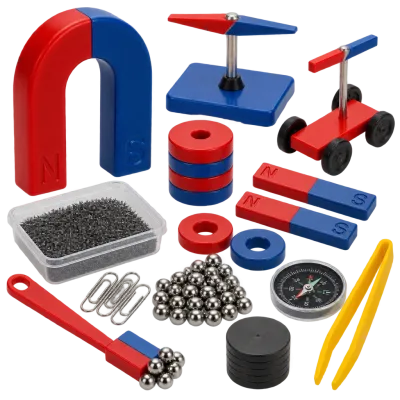 Matching productMagnet science kit for kidsAmazon →

07
Frequently asked questions
Why can't one magnet simply float above another?
Static magnetic fields don't form a stable pocket. According to Earnshaw's theorem at least one direction stays unstable, so without control, spin, diamagnetism or guidance the magnet flips away.
How fast is the fastest maglev train?
The record belongs to Japan's SCMaglev at 603 km/h (375 mph), set in 2015. In regular passenger service, the Shanghai line currently runs at up to 300 km/h (186 mph).
Does a maglev train float when it is stopped?
That depends on the system. The Transrapid hovers at standstill thanks to its controlled electromagnets. The SCMaglev only lifts off at around 150 km/h and rolls on wheels before that.
Does a floating globe need power all the time?
Yes. The electronics in the base adjust without pause. If the power goes out, the globe comes down.
Sources:
Explore
Read next
 Types of MagnetsFrom bar magnets to neodymium super magnets: an overview of the most important types of magnets and their uses.
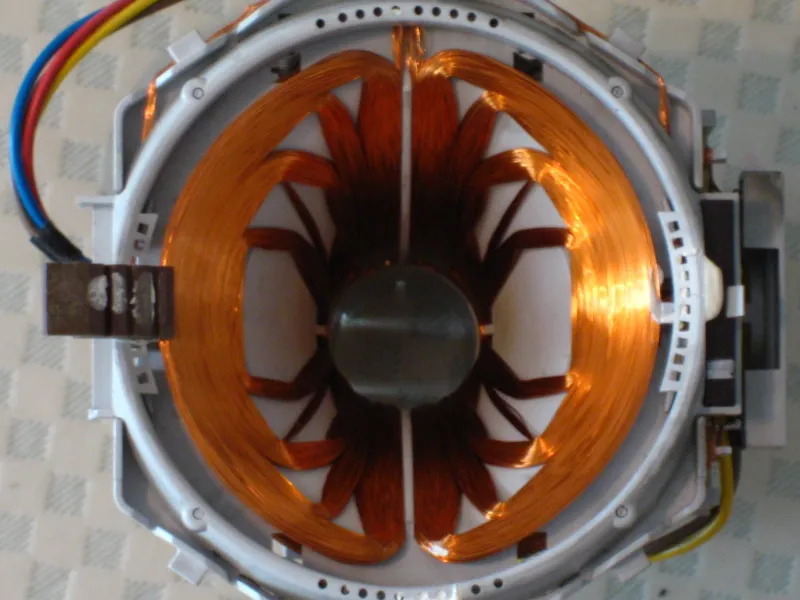 Uses of MagnetsMagnets are used far beyond speakers and fridges: learn about their role in data storage, deflection magnets and relays.
 Magnetism: What Is It?What is magnetism, how does it arise physically and what can you do with it? We take a closer look at this fascinating phenomenon.