
6 min read
Earth's Magnetic Field and the Compass Explained
From the geodynamo in Earth's core to magnetic declination: how the field works, how animals use it and how to build your own compass.
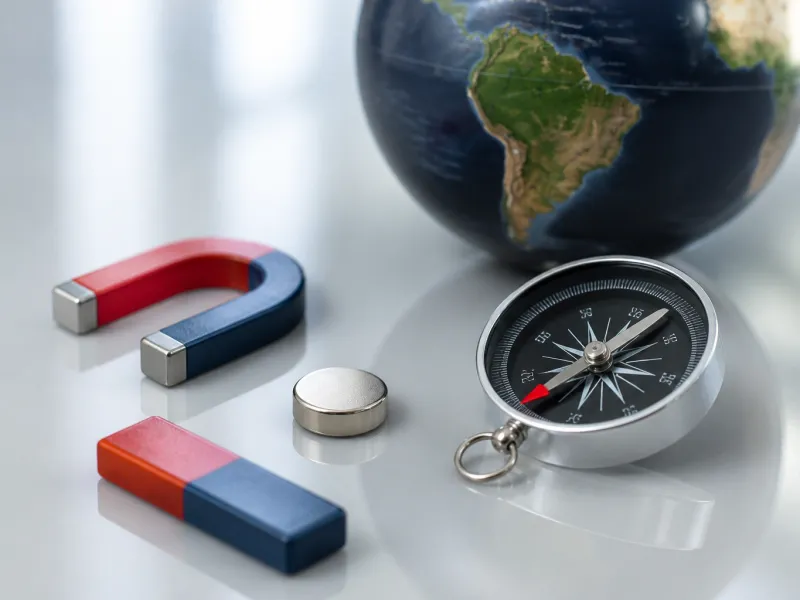
You carry it with you every second, yet you never feel it: Earth's magnetism. It makes every compass needle swing north, guides migrating birds across continents and shields our atmosphere from the solar wind. Still, few people know how this invisible field actually comes about.
In this guide you will learn where Earth's magnetic field comes from, why compass north is not the same as map north, what declination means and whether a pole reversal is something to worry about. At the end, you will build your own compass from simple household items.
01
How Earth's magnetic field is created
Almost all of Earth's magnetic field comes from deep inside the planet. Around 1,900 miles beneath your feet lies the outer core, a layer of liquid, extremely hot metal that is mostly iron. This material conducts electricity and is constantly moving, because heat flows outward from the depths. Earth's rotation twists these flows even further.
Moving, conductive metal produces electric currents, and those currents in turn produce a magnetic field. The field strengthens the currents and the currents strengthen the field: scientists call this the geodynamo. Common estimates attribute about 95 percent of the field to this mechanism. The rest comes from sources such as magnetized rocks in the crust and currents in the upper atmosphere.
Compared with a neodymium magnet, Earth's field is very weak. At the equator it measures about 30 microtesla, and near the poles roughly twice that. In central Europe the total strength is around 48 microtesla. For comparison, a small neodymium magnet easily reaches ten thousand times that at its surface.
Weak as it is, the field does a huge job. Far out in space it forms the magnetosphere, a kind of shield that deflects charged particles from the solar wind. Without it, the solar wind could slowly strip away the atmosphere, as probably happened on Mars long ago. The northern and southern lights show you where some of those particles still get through.
 Matching productNeodymium disc magnets setAmazon →
02
Magnetic north vs. geographic north
The geographic North Pole is the point where Earth's axis of rotation comes out. The magnetic north pole, on the other hand, is the place where the field lines point straight down into the ground. The two are not in the same spot, and the magnetic pole wanders. Since James Clark Ross first located it in the Canadian Arctic in 1831, it has moved a long way toward Siberia. Around 2019 it was traveling more than 30 miles per year at times.
| Term | What it means |
|---|---|
| Geographic North Pole | Northern end of Earth's axis, fixed and at the top of every map |
| Magnetic north pole | Where field lines point straight down, constantly moving |
| Geomagnetic north pole | Calculated pole of a simplified dipole model, in yet another place |
There is a fun physics twist, too: opposite poles attract, and the north end of your compass needle points north. So Earth's magnetic north pole is, physically speaking, a magnetic south pole. The name refers to its location, not its polarity.
03
Declination: why your compass is slightly off
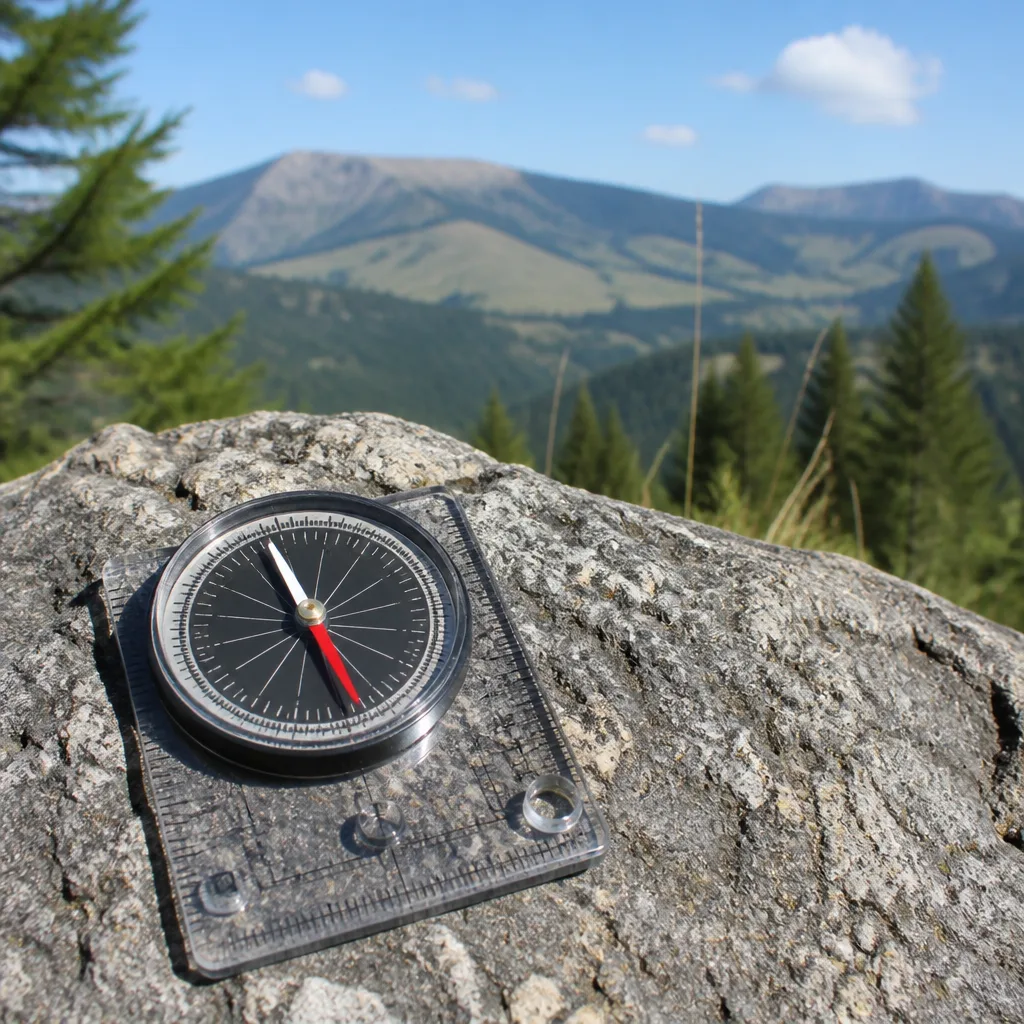
The angle between compass north and true north is called magnetic declination, or variation. It depends on where you are and changes over the years. Keep in mind that the needle does not aim straight at the magnetic pole. It follows the direction of the field right where you are standing, which is why declination has to be measured and modeled instead of worked out with simple geometry.
If magnetic north lies east of true north, declination is east (positive); otherwise it is west (negative). In practice:
- Look up the current value: Good topographic maps print the declination in the margin. For an up to date value at your location, try the NOAA declination calculator.
- Do the math: Add east declination to your compass bearing and subtract west declination to get the true bearing.
- Avoid interference: Iron, cars, power lines and magnets nearby will throw off the reading.
Smartphones rely on global field models such as the World Magnetic Model for their compass apps as well. It is updated regularly, most recently in its 2025 edition.
 Matching productMagnet science kit for kidsAmazon →
04
Pole reversal: is the field about to flip?
Earth's magnetic field has flipped direction many times throughout its history. The evidence is written in magnetic stripes on the seafloor: fresh lava records the direction of the field as it cools, much like a data tape. Over roughly the past 83 million years there have been at least 183 reversals, but they are very irregular. Sometimes several came close together, and sometimes the field stayed stable for tens of millions of years.
The last full reversal, named after the researchers Brunhes and Matuyama, happened about 780,000 years ago. Shorter swings called excursions have occurred since, for example about 41,000 years ago. A reversal usually takes a few thousand years. The field does not vanish completely during that time, and statistical studies find no link between reversals and mass extinctions. Nobody can predict when the next one will happen.
05
Animals with a magnetic sense
Many animals use Earth's magnetic field to find their way. In 1972, Roswitha and Wolfgang Wiltschko showed with European robins that migrating birds sense the tilt of the field lines. Rather than telling north from south, they distinguish "toward the pole" from "toward the equator."
- Sea turtles read the strength and tilt of the field like a rough map and use it to navigate across entire oceans.
- Salmon and spiny lobsters also orient themselves magnetically.
- Homing pigeons, bees and even mole rats have been shown to respond to magnetic fields.
Exactly how this sense works is not fully understood. In birds, a light dependent process in eye proteins called cryptochromes is considered the leading candidate. Whether humans have a magnetic sense remains an open question.

06
Build your own compass
The compass is an ancient invention. Chinese sources describe magnetized needles for navigation as early as the 11th century, and the compass reached Europe toward the end of the 12th century. Today you can build one yourself with just a few things:
- A sewing needle or a straightened paper clip
- A magnet, ideally a neodymium magnet
- A piece of cork, a leaf or a slice of foam
- A bowl of water
Stroke the needle several times with the same pole of the magnet, always in the same direction, lifting the magnet away between strokes. Then place the needle on the cork and float it gently on the water. After a moment the needle turns to line up north and south. The water keeps friction to a minimum. Keep phones, cutlery and the magnet away, or they will pull the needle off course. And since the needle is sharp, stay close when younger kids join in.
07
Frequently asked questions
Does a compass point exactly to the North Pole?
No. It follows the local magnetic field. The difference from true north is the declination, which you should account for when taking precise bearings.
Is a pole reversal dangerous for us?
It unfolds over long periods, and the field does not disappear entirely. Past reversals cannot be linked to mass extinctions.
Why do compasses work poorly near the poles?
There the field lines point almost straight down, so the horizontal pull on the needle becomes very small. That is why manufacturers balance their needles for specific regions of the world.
Can a magnet permanently mess up my compass?
Yes. A strong magnet can remagnetize the needle or even reverse its polarity. Store your compass and your magnets separately.
Sources:
Explore
Read next
 Types of MagnetsFrom bar magnets to neodymium super magnets: an overview of the most important types of magnets and their uses.
 Uses of MagnetsMagnets are used far beyond speakers and fridges: learn about their role in data storage, deflection magnets and relays.
 Magnetism: What Is It?What is magnetism, how does it arise physically and what can you do with it? We take a closer look at this fascinating phenomenon.