
5 min read
Magnetism: What Is It?
What is magnetism, how does it arise physically and what can you do with it? We take a closer look at this fascinating phenomenon.
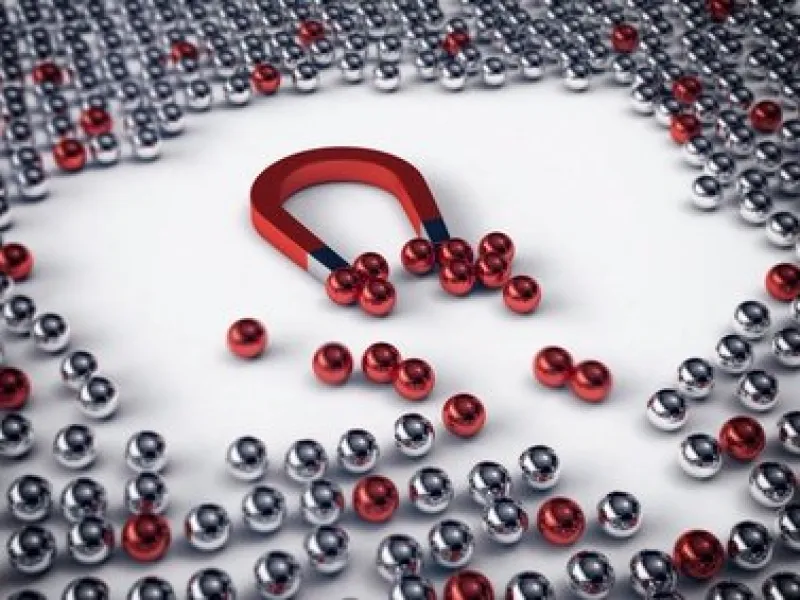
For children in particular, but also for many adults, they are among the most fascinating things physics has to offer: magnets. The nice thing is that the force behind them, magnetism, can be observed in many places in everyday life. But what exactly is magnetism, how does it come about from a physical point of view and what can you do with it? That is exactly the phenomenon we want to get to the bottom of here.

First, we need to distinguish a few terms and make them more precise. When people talk about magnets and magnetism in everyday life, many of them mean only what is called ferromagnetism. We encounter it in many places in our daily lives, for example on the magnetic board found in countless households, a wall board made of metal or sheet steel on which notes and other everyday items can be attached with small magnets. Anyone who owns a metal refrigerator can simply attach notes to it with suitable magnets. This is exactly where we are dealing with ferromagnetism. It refers to the magnetic properties of ferrum, better known as iron. We can also observe magnetism in other everyday objects, for example in a compass.
It follows that: in everyday life we associate magnets and magnetism mainly with objects made of iron and steel. In physics, however, it is known that other substances are magnetic too, including nickel and cobalt.
In addition, many people have misconceptions about how easily different materials can be magnetized. It is widely assumed that ordinary steel can be magnetized permanently. That is not correct, though. Steel, at least when it has not been refined, is considered a magnetically soft material. It can be magnetized, but it loses this property again after a short time. So for permanent magnetization, you have to make sure to use what are called magnetically hard materials. Only these retain their magnetism over a long period. This is also the reason why compass needles cannot be made from ordinary steel wire, which is also magnetically soft.
Whether an object is magnetic can easily be checked with a permanent magnet. If the permanent magnet is brought close to the object and the object is magnetic, a magnetic force can be felt. In other words, the object is attracted. However, this does not tell you whether the object is permanently magnetized. To find that out, you have to do the reverse test. A piece of magnetizable material, for example iron or steel, is brought close to the object. If this test piece is attracted, the object is permanently magnetized.
In our everyday lives, magnetism is sometimes desirable and sometimes undesirable. For example, tools are deliberately magnetized to make them easier to handle. The best example is screwdrivers with a magnetized tip, which hold the screw by themselves. Anyone who has ever worked with such a screwdriver will certainly appreciate the magnetic tip.
01
The history of magnetism
Before we get into the technical details of magnetism, you should first know how long humans have known about magnetism and, therefore, how long it has been used for their purposes. One of the oldest objects that deliberately works with magnetism is the compass. The principle behind it, however, was used even before people understood exactly how it worked. Long before the birth of Christ, advanced peoples used so-called lodestones to determine the cardinal directions.
It was ultimately the Roman poet Lucretius who named these stones after a region in Greece, giving them the distinctive name Magnesia. From this, the terms magnet and magnetism that we still know today eventually developed.
In the Middle Ages, the properties of magnetism were first used to magnetize special metal needles and use them in a compass as we still know it today. It was in particular the English naturalist Alexander Neckam who researched this field and kept corresponding records.
However, the fundamental causes of magnetism remained unexplored well into the 18th century. Knowledge of the lines of force of magnets and other fundamentals of magnetism was discovered and documented only relatively recently. This also applies to the connection between electric current and magnetism, which was discovered in 1820 by Hans Christian Ørsted. His work is now considered the foundation of modern electrical engineering.
 Matching productMagnet science kit for kidsAmazon →
02
Magnetism as a physical phenomenon
In physics, magnetism is a phenomenon that manifests itself as a force between magnetized objects. Magnetism also appears in objects with moving electric charges, for example in conductors carrying an electric current. The region in which this force acts is called the magnetic field. It is the force field generated by a magnetized object. Magnetic fields can interact with each other, which means an object can generate a magnetic field itself and at the same time be influenced by another magnetic field.
To document the effects of magnetic fields, so-called field lines are used. They show the course of the force within the magnetic field. The spacing between the magnetic field lines represents the strength of the field: the closer together the field lines are, the stronger the magnetic field. All magnetic field lines form closed loops, so a field line has no beginning and no end. To make the field lines visible, we use either a compass needle or, alternatively, iron filings.
03
The Earth, humans and magnetism
Infographic: magnetism
Magnetism plays a major role on our planet. As long as no other force acts on it, a magnetic object will always align one of its ends toward the north, while the other end points toward the South Pole. This is exactly why we speak of north and south poles. Science assumes that the field lines of a magnet leave it at the north pole and enter it again at the south pole.
Since we humans are a significant part of planet Earth, magnetic fields are constantly at work in our bodies as well. They result from the activity of our nerves, which is based on electric current. This current in turn produces very weak magnetic fields, which can nevertheless be recorded with sensitive measuring instruments. Conversely, this means that magnets can influence the human nervous system, as has already been scientifically documented in many experiments. This is why the power of magnetism is used for various purposes, especially in medicine, for example to stimulate muscles or nerves.
Explore
Read next
 Types of MagnetsFrom bar magnets to neodymium super magnets: an overview of the most important types of magnets and their uses.
 Uses of MagnetsMagnets are used far beyond speakers and fridges: learn about their role in data storage, deflection magnets and relays.
 Magnet GlossaryKey terms relating to magnets and magnetism, clearly explained.